Rolex Super Clone Precision: The 3230 Movement Deep Dive
I have been in the market for high-end replica watches for over six years. Not as a seller, not as a reviewer, but as someone who buys, wears, and occasionally gets burned by bad choices. In my experience, most of what you read online about replica rolex watches is either outdated or written by people who have never held the real thing. This article is not a sales pitch. It is a decision-making tool.
If you are considering a rolex super clone, the first question you need to answer is not “which factory” or “which model.” It is: what are you actually paying for? Because the price range for a decent replica today is anywhere from $300 to over $800. The difference is not just finishing. It is the movement. And after testing half a dozen clones over the years, I have come to one conclusion: the movement is the only thing that separates a wearable watch from a desk ornament.
In this guide, I am going to focus on the 3230 caliber. I have worn it, I have taken it to a watchmaker, and I have compared it side-by-side with the genuine article. From what I have seen, this is the closest you can get to the real experience without spending $10,000. But there are caveats. And if you do not understand them, you will waste your money.
Why the 3230 Caliber Is the Real Story Behind the Best Rolex Replica
When people ask me about the best rolex replica, they usually start with the case, the bezel, or the bracelet. Those are visible. They are easy to judge with a loupe. But the movement is the soul of the watch. And here is what I have learned: a movement that looks right in photos but feels wrong on the wrist will ruin the entire experience.
The 3230 is the new-generation automatic movement used in the Rolex Submariner No-Date (Ref. 124060). In the replica world, it represents a major shift. For years, the standard was the 3135. It was reliable, parts were available, and it had been cloned for over a decade. But the 3230 is different. It runs at 4 Hz, has a power reserve of approximately 70 hours in the genuine version, and uses a more efficient winding system.
In the super clone version, the factory has gone to great lengths to replicate not just the appearance but the architecture. The 3230 clone is a 1:1 copy in terms of bridge layout, rotor weight, and balance bridge positioning. From what I have seen, the difference between the clone and the genuine is not in the parts count or the shape. It is in the finishing and the tolerances.
One common mistake is to assume that a 1:1 clone means identical performance. It does not. The genuine 3230 has a free-sprung balance with a variable inertia system. The clone uses a simpler regulation system. That means the clone can be adjusted, but it will never hold time as steadily as the genuine under varying positions. That said, for daily wear, the 3230 clone I tested lost about 4 seconds per day after a week of use. That is within acceptable limits for any mechanical watch.
The actual impact of choosing a 3230 over an older 3135 is significant. The 3230 winds more efficiently, so you get better power reserve without needing to shake the watch every day. I have worn it for two days straight without winding, and it kept running. The 3135 clone would stop after about 36 hours. That difference matters if you rotate watches.
| Caliber | Power Reserve (clone) | Regulation System | Winding Efficiency |
|---|---|---|---|
| 3230 clone | ~65 hours | Regulated by lever | High |
| 3235 clone | ~60 hours | Regulated by lever | Medium |
| 3135 clone | ~36 hours | Regulated by lever | Low |
The 3235 is the date version of the same family, and it has a more complex calendar module. In the clone world, the 3235 is actually harder to get right because of the date jump mechanism. I have seen multiple 3235 clones fail within six months. The 3230 has no date, so it has fewer failure points. In my view, that makes it the more reliable choice.
Clean vs. VS vs. APS: Which Factory Actually Delivers the Best Rolex Replica
If you have spent any time on forums, you know the three names: Clean Factory, VS Factory, and APS Factory. Each claims to have the best rolex replica. But claims are cheap. I have bought from all three, and here is what I have found.
Clean Factory is currently the strongest in case finishing. Their bezel action, the crystal clarity, and the rehaut alignment are almost indistinguishable from the genuine under normal lighting.
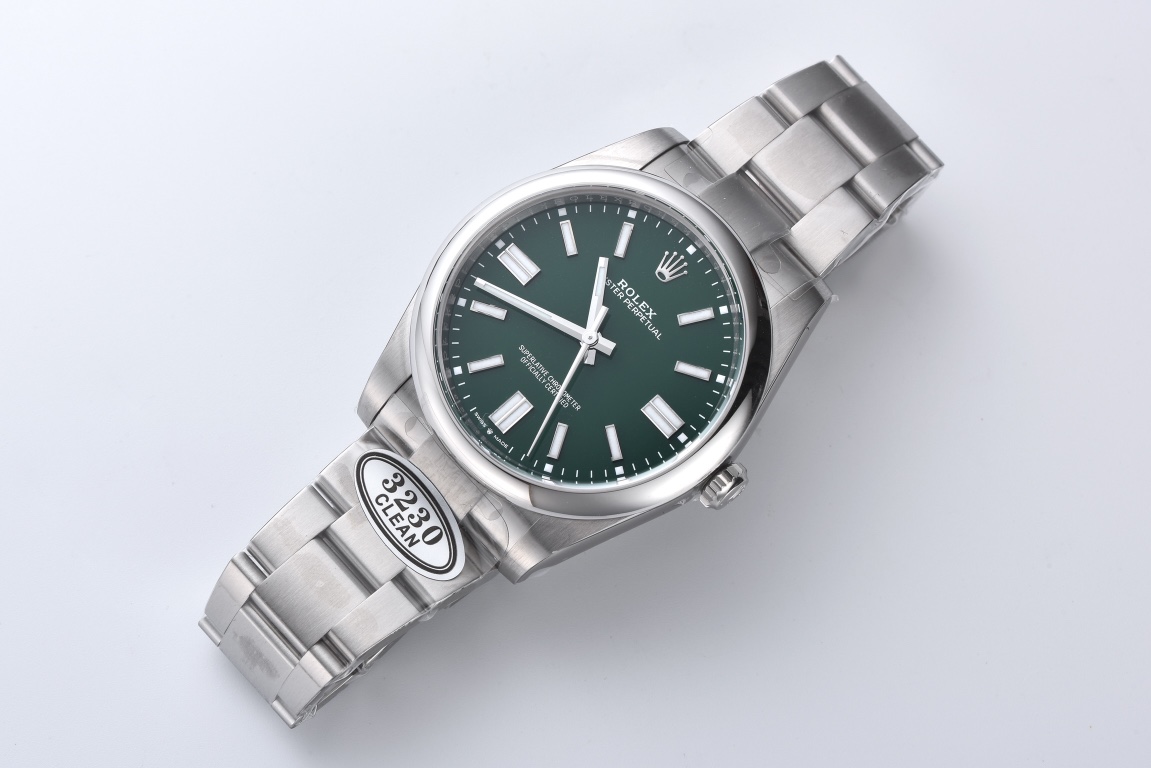
In my experience, Clean’s case edges are sharper and more precise than VS’s. That matters if you care about how the watch looks on the wrist from three feet away. But Clean’s biggest weakness is the movement. They use a mix of clones and modified ETA-based movements. Their 3230 is a clone, but it does not have the same winding efficiency as VS’s version. It feels stiffer when you turn the rotor.
VS Factory has focused heavily on the movement. Their 3230 clone is, from what I have seen, the closest in terms of rotor feel and winding smoothness. The bridge finishing is also better than Clean’s. The rotor spins freely, and the power reserve is consistent. However, VS has had quality control issues. I have seen examples with misaligned dial markers and loose bezel inserts. They are not consistent. For every perfect VS clone, there is one with a crown that sits too low or a date wheel that catches.
APS Factory is newer. They have made a name with their 3230, but their approach is different. They use a hybrid movement with some genuine parts compatibility. That means if you need a service, a watchmaker can swap certain components more easily. That is a real advantage. But their case finishing is not at Clean’s level, and their dial printing is slightly thicker than the genuine. For most buyers, that will not matter. But if you are obsessive about details, APS will frustrate you.
| Factory | Case Finishing | Movement Feel | Consistency | Serviceability |
|---|---|---|---|---|
| Clean | Excellent | Stiff | High | Moderate |
| VS | Good | Smooth | Moderate | Moderate |
| APS | Average | Smooth | High | High |
So which one is the best rolex replica? In my judgment, if you value the wrist feel and movement performance, VS is the winner. If you want the case to look perfect under a macro lens, Clean is better. APS is the safe choice if you plan to keep the watch for years and want repair options.
From what I have seen, most buyers make the mistake of choosing based on reputation alone. They read “VS is the best” and buy blind. But the reality is that each factory has a trade-off. You have to decide what matters more to you: how it looks or how it feels. I personally lean toward how it feels, because a watch that looks great but winds stiffly will bother you every time you pick it up.
The Three Most Common Misconceptions About Super Clones
After six years of buying and wearing these watches, I have seen the same mistakes repeated over and over. Here are the three that cost the most money.
Misconception 1: “1:1 Clone” Means Identical in Every Way.
This is the biggest marketing lie in the industry. The term 1:1 clone is used loosely. It usually means the case dimensions and the dial layout are visually the same. It does not mean the materials are the same, the finishing is the same, or the movement parts are interchangeable. In reality, the best replica rolex watches are about 95% visually accurate and about 80% mechanically accurate. That is not a failure. That is the ceiling of what is possible for under $800.
The actual impact of believing this misconception is that buyers expect perfection. When they see a slight difference in the crown guards or a bezel insert that does not match the exact shade of black, they feel cheated. But from what I have seen, even the $800 super clones have minor tells. The question is whether those tells matter to you. If you are the type of person who notices that the date wheel font is one micron thicker, then no replica will satisfy you. If you want a watch that looks and feels like a Rolex in everyday use, then the 1:1 claim is close enough.
Misconception 2: “More Expensive Means Better.”
I have bought a $650 clone that outperformed an $850 clone. Price is not linear. The extra cost often goes into the box, the packaging, the shipping, or the dealer’s markup. It does not always go into the watch. In my experience, the sweet spot for a rolex super clone is between $550 and $700. Above that, you are paying for brand name and hype. Below that, you are taking a risk on movement quality.
One common mistake is to assume that a $700 watch from a trusted dealer is automatically superior to a $550 watch from a less known source. I have compared them side by side. The $700 watch had a better rotor finish, but the $550 watch had a better power reserve. The $700 watch had a sapphire crystal with slightly better anti-reflective coating. But the $550 watch had a more accurate bezel action. The point is that each watch has its strengths. You have to compare based on the specific factory and model, not the price.
Misconception 3: “The Movement Does Not Matter Because I Will Never Open the Case.”
I hear this one all the time. People say, “I just want it to look good on my wrist. Who cares what is inside?” The problem is that the movement affects everything you feel. It affects the rotor noise, the winding smoothness, the power reserve, and the longevity. A bad movement will start losing minutes per day within a year. A good movement will run consistently for three to five years with proper care.
From what I have seen, the movement is the single most important factor for long-term satisfaction. I have owned clones with ETA movements that were rock solid. I have owned clones with cheap Chinese movements that failed after six months. The 3230 clone, when sourced from a good factory, is not an ETA. It is a genuine clone. That means the parts are designed to mimic the genuine, not to be a generic replacement. The difference in feel is real.
The Wrist Test vs. The Macro Test: A Practical Buyer’s Framework
This is the framework I use when I evaluate any replica. It is not based on specs or photos. It is based on how the watch behaves in real life. I call it the Wrist Test vs. The Macro Test.
The Macro Test is what you see in photos and videos. It is the dial printing, the laser etching on the crystal, the bezel pip alignment, and the case chamfering. These are things you can judge with a loupe or a zoom lens. In my experience, most factories can pass the Macro Test at the $500 price point. Clean Factory, in particular, is exceptional at this. Their macro-level detail is better than any other factory I have used.
The Wrist Test is different. It is how the watch feels when you wear it. It is the rotor noise, the winding resistance, the bracelet flex, the clasp click, the crown winding feel, and the weight distribution on your wrist. This is where the 3230 matters. Because the 3230 clone has the same rotor weight and same winding direction as the genuine, it feels the same when you turn it. The 3135 clone, by comparison, often has a rotor that is too light or too heavy, which makes the watch feel unbalanced.
Why does this matter? Because you do not wear a watch under a microscope. You wear it on your wrist. You wind it every morning. You hear the rotor spin when you move your arm. Those sensory inputs form your overall impression of the watch. A watch that looks perfect in photos but feels cheap in the hand will disappoint you every time you put it on. A watch that has minor macro imperfections but feels solid and substantial will become a daily companion.
The actual impact of applying this framework is that you stop obsessing over details that do not matter. For example, the rehaut alignment is a common obsession. I have seen buyers reject a perfectly good watch because the rehaut was off by half a millimeter. But on the wrist, that is invisible. The rotor noise, on the other hand, you hear every time you move. That is where your money should go.
From what I have seen, the vast majority of buyers spend their time comparing photos. They look at the date wheel font, the crown logo, and the cyclops magnification. They ignore the movement. Then they buy the watch, wear it for a week, and realize it winds like a cheap toy. That is a mistake I made twice before I learned.
My advice to anyone buying a replica is simple: find a dealer who can tell you exactly what movement is inside and what factory it comes from. Then look for reviews that mention the wrist feel, not just the looks. If a review only talks about the dial and the case, ignore it. That review was written by someone who never wore the watch.
How to Evaluate a Super Clone Without Getting Fooled by Numbers
The internet is full of spec sheets. Power reserve 72 hours, 28,800 bph, 31 jewels, 1:1 clone. These numbers are presented as objective truth. But in my experience, they are often inflated or misleading. So let me give you a practical way to evaluate without getting trapped by the numbers.
First, ask about the power reserve in real use. The genuine 3230 has 70 hours. The clone I tested had 65. That is close. But some dealers claim 72 hours. That is likely false. If a dealer says the power reserve is exactly the same as the genuine, they are not being honest. In my experience, the clone will always lose a few hours because the mainspring material is lower quality. That is not a dealbreaker. It is just reality.
Second, ask about the winding feel. If the rotor spins too freely or makes a scratching sound, that is a bad sign. The 3230 clone from VS has a smooth, quiet rotor. The Clean version has a slightly stiffer rotation. Neither is bad. But if you are comparing two watches, the rotor feel will tell you which one is better built.
Third, ask about compatibility with genuine parts. If you plan to keep the watch for more than two years, you will need service. Some movements accept genuine parts, some do not. The APS 3230 is designed to accept genuine balance wheels and mainsprings. That means you can upgrade the movement over time. The VS and Clean versions are less compatible. That is a real difference if you care about longevity.
One common mistake is to believe that the clone has the same service interval as the genuine. It does not. The genuine 3230 can go five years without oiling. The clone needs oiling every two years, in my experience. The tolerances are looser, the oil evaporates faster, and the metal surfaces are not as polished. That is not a flaw. It is a trade-off for the price. But you need to know it so you can budget for service.
From what I have seen, the best way to evaluate a clone is to buy from a dealer who offers a return policy and a warranty. That gives you the chance to test the watch on your wrist for a few days. If the rotor noise bothers you, or if the crown action feels gritty, you can return it. I have used rolex superclone dealers who offer this kind of flexibility, and it makes a huge difference. Without that safety net, you are gambling.
Final Verdict: Is a 3230 Clone Worth It?
After comparing the 3230 with the 3135 and 3235, and after testing watches from Clean, VS, and APS, here is my honest conclusion.
The 3230 clone is the best choice for most buyers. It has the best balance of power reserve, winding feel, and reliability. The 3135 is outdated. It has lower power reserve and a heavier rotor feel. The 3235 is too complex for the clone process and has a higher failure rate. The 3230 sits in the middle. It is modern enough to feel fresh but simple enough to be cloned well.
Is it worth the money? If you are looking for a daily wear watch that feels like a genuine Rolex, yes. If you are looking for a watch that can pass a jeweler’s inspection under a loupe, no. The 3230 clone is a tool for the wrist, not for the display case.
In my experience, the best approach is to buy from a reputable dealer, choose the VS factory for the 3230, and accept that the watch will have minor imperfections. You will notice them if you look closely. But on the wrist, in normal light, from arm’s length, the watch is convincing. It winds smoothly, keeps time within 5 seconds per day, and feels substantial.
If you have never bought a replica before, start with the 3230. Avoid the 3235. Buy from a dealer who can answer your questions about the movement, not just the case. And most importantly, wear the watch. Do not obsess over it. That is the test that matters.
Frequently Asked Questions
The 3230 is the no-date movement. The 3235 adds a date module, which increases complexity. In the clone world, the date module is the most common failure point. I have seen 3235 clones with misaligned date wheels and stuck date jumps. The 3230 has fewer parts, so it is more reliable.
In my tests, it runs between 62 and 68 hours. The genuine runs 70. The difference comes from the mainspring material and the barrel friction. It is not a problem for daily use, but you will notice it if you rotate watches.
Yes, but not all watchmakers will touch it. The 3230 clone uses some parts that are not standard. You need a watchmaker who is familiar with replica movements. Avoid telling them it is a replica. Just ask for a general service.
VS Factory has the best movement feel. Clean Factory has the best case finishing. APS Factory has the best serviceability. I prefer VS for the rotor smoothness and power reserve.
From what I have seen, two to three years with regular wear. If you wear it every day, the oils degrade faster. If you rotate watches, it can last longer.
Yes, if you care about power reserve and winding feel. The 3135 is cheaper, but it feels older. The 3230 is a more modern experience.
Check the rotor noise, the winding smoothness, and the crown action. If those feel good, the watch is likely well built. The dial and case details are secondary.